How VALORANT Champions Shanghai Group Stage Day 8 reshaped the 2026 title race
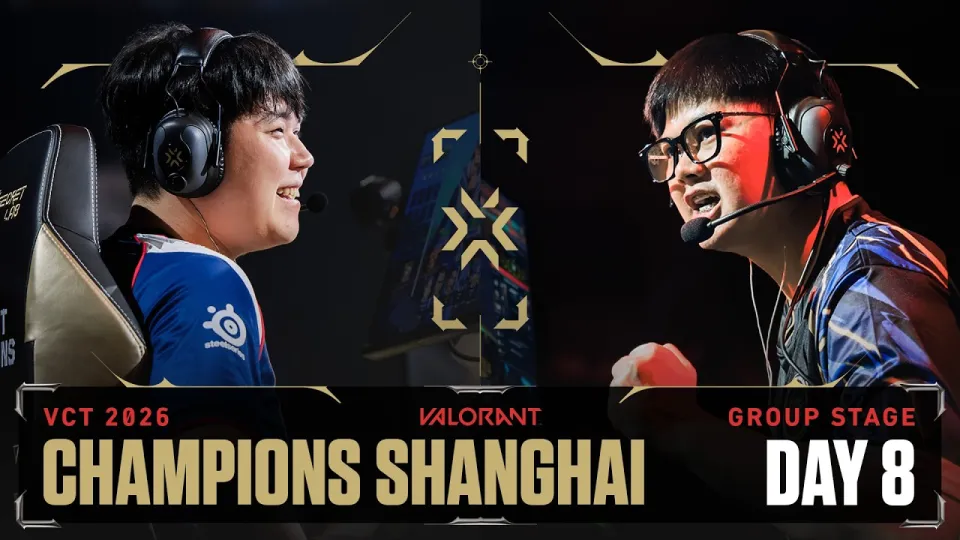
Video: VALORANT Champions Shanghai — Group Stage — Day 8
Need articles like this for your video? They help promote it on YouTube and Google — order them in the Telegram bot @sat_sit_bot. The bot writes and publishes the articles itself (with your YouTube video embedded) on popular topical websites (no ads). Try it free: 50 articles on us.
· based on the channel VALORANT Champions Tour
Key takeaways
- Day 8 of the VALORANT Champions Shanghai group stage aired on the VALORANT Champions Tour channel on 02.10.2026, covering the T1 vs JD Gaming series and the day's earlier match.
- Shanghai hosts 16 teams from Americas, CN, EMEA and Pacific from September 24 to October 18, all fighting for the 2026 world title.
- A tech pause interrupted the first game of the day, and the broadcast also showed a T1 vs JD Gaming series that went the full three maps.
- Chinese representatives went 0-4 in the group stage, which sparked the loudest debate in the comments under the VOD.
- Two Masters events in 2026 already produced new champions, so Shanghai is the first world championship where those winners meet the rest of the field.
VALORANT Champions Shanghai is the 2026 world championship, and Group Stage Day 8 is the broadcast where the group phase stopped being about seeding and started being about survival. The day's VALORANT action on the VALORANT Champions Tour channel covered a full three-map series between T1 and JD Gaming plus the earlier match on the schedule, and it ended with every Chinese representative out of the tournament. You can follow the official bracket, schedules and announcements through the VALORANT Esports account on X, which is the fastest place to check results as they happen.
What Day 8 of the Shanghai group stage actually contained
Day 8 was built around two series and one long interruption. The first game of the day ran to a finish before a technical pause stopped play for roughly a minute, and the second series between T1 and JD Gaming needed all three maps to decide a winner. The broadcast itself is a marathon: the VOD runs well past the four-hour mark, with the first game starting around the 35-minute point, the tech pause landing just past the one-hour mark, and the T1 vs JDG maps spread across the second half of the stream. For anyone who only wants the competitive picture, the useful takeaway is simple: one team closed its group campaign cleanly, the other burned through its map pool to stay alive.
Why the Chinese teams going 0-4 dominated the conversation
Four CN representatives entered the group stage and none of them advanced, which turned the comment section into a referendum on regional strength. The most-liked argument in the thread pushed back on the idea of a "regional curse": in that view, home pressure is not a handicap for everyone, and the Chinese squads simply were not ready for the level of the international field. A second camp pointed at the slot allocation, arguing that free VCT slots for the region produced a weaker average than a merged APAC pool would. Both readings are opinions, not results, but they frame the real question heading into the playoffs: whether CN's 2026 showing is a one-off roster cycle or a structural gap.
The JD Gaming collapse that decided the day
The most concrete complaint about Day 8 is not about region at all, it is about a single map. JD Gaming held a 6-11 lead on map one and lost it, a comeback that would have been an almost unheard result for a CN team on the global stage. Had that map closed, the series could plausibly have ended 2-0 and the entire narrative of the day would read differently. Instead the match stretched to a third map, and by the closing stages JDG's play fell apart badly enough that viewers described the final map as the point where the series was simply given away. That is the difference between a group-stage exit and a playoff seed.
The Crown silence, the Omen hit and other small moments people rewatched
Individual moments carried as much weight as the scorelines. The single most satisfying beat for many viewers was a Crown getting silenced at a key moment, a small utility decision that quietly swung a round. Two other clips kept getting replayed: a kill on Omen where viewers counted three bullets landing but only two registering on the damage feed, and a headshot that the broadcast did not credit as one, which drew direct complaints toward the game's hit registration. There was also visible confusion about T1 putting a player on a duelist role, and a running joke about the venue sounding so quiet that it felt like a library. None of these change the standings, but they are exactly the details that make a VOD worth rewatching.
How the 2026 season set up this Shanghai bracket
The description of the broadcast frames Shanghai as the convergence point of a season that already broke its own patterns. Two Masters events in 2026 produced new champions, meaning the established order had already been challenged twice before the world championship began. Shanghai, running from September 24 to October 18, puts 16 teams from Americas, CN, EMEA and Pacific into one bracket for the biggest trophy of the year. Day 8 is where that bracket stopped being theoretical: teams that looked comfortable in their own regions had to solve opponents with completely different defaults, and the ones that could not adapt are already gone.
Picking apart the recurring viewer questions
The questions under the VOD cluster around three things: how the bracket works, why certain plays looked wrong on the broadcast, and whether the Chinese results mean anything beyond this event. On format, the group stage feeds into a playoff bracket where seeding matters, so a lost map in a series like T1 vs JDG is not cosmetic, it can decide which side of the bracket a team lands on. On broadcast oddities, damage numbers and headshot calls are read from the spectator client, and small desyncs between what viewers see and what the server registers are a known artifact of observing a live match. On the regional question, one tournament sample is thin evidence; the honest answer is that CN's 2026 group stage was a failure by results, and whether it is a trend depends on the next international cycle.
Useful links
- VALORANT Esports on X — official results, brackets and announcements
- VALORANT Esports on Facebook
- VALORANT Esports on Instagram
- VALORANT Esports on TikTok
- VALORANT on Twitch — live broadcasts and VODs
What Day 8 means for the rest of VALORANT Champions Shanghai
Day 8 mattered less for who won and more for what it exposed. A three-map series that should have been a clean 2-0 showed how thin the margin is between advancing and flying home, and a full regional wipeout removed any cushion for the remaining CN narrative. The teams still alive now have to convert group-stage form into playoff resilience, because the bracket does not reward the team that looked best in September, only the one that survives October. For the full match-by-match breakdown, the VALORANT Champions Tour channel is the source to follow, and the fastest way to keep up with the bracket as it narrows is the official VALORANT Esports account on X.
Source: VALORANT Champions Shanghai — Group Stage — Day 8 · Markdown version
Questions & answers
Did any Chinese team advance from the VALORANT Champions Shanghai group stage?
No. All four CN representatives were eliminated during the group stage, which is the result that generated most of the debate under the Day 8 broadcast. The argument in the comments split between those blaming regional pressure and those blaming the slot allocation for the region. Either way, the standings are what they are: zero CN teams in the playoff bracket.
Why did JD Gaming lose to T1 if they led on the first map?
JDG held a 6-11 lead on map one and could not close it, a comeback that would have been an almost unprecedented result for a CN team on the international stage. Had that map finished, the series could have ended 2-0. Instead it went to a third map, where JDG's level dropped sharply and the series slipped away.
What caused the technical pause during Day 8?
A technical pause stopped play during the first game of the day and lasted roughly a minute before the match resumed. Pauses of that length are usually server or client-side issues rather than anything to do with the teams, and the broadcast filled the gap with analysis before returning to the server.
Why did some kills look wrong on the broadcast, like the Omen hit or the uncounted headshot?
Spectator clients can show damage and hit feedback slightly out of sync with what the server registers, so viewers sometimes count bullets or headshots differently than the game does. It is a known artifact of observing live matches rather than a rule change. The official result always follows the server, not the on-screen overlay.